Overrun
A Resident’s Report on a City Past Its Limits
Cover — provided as a courtesy
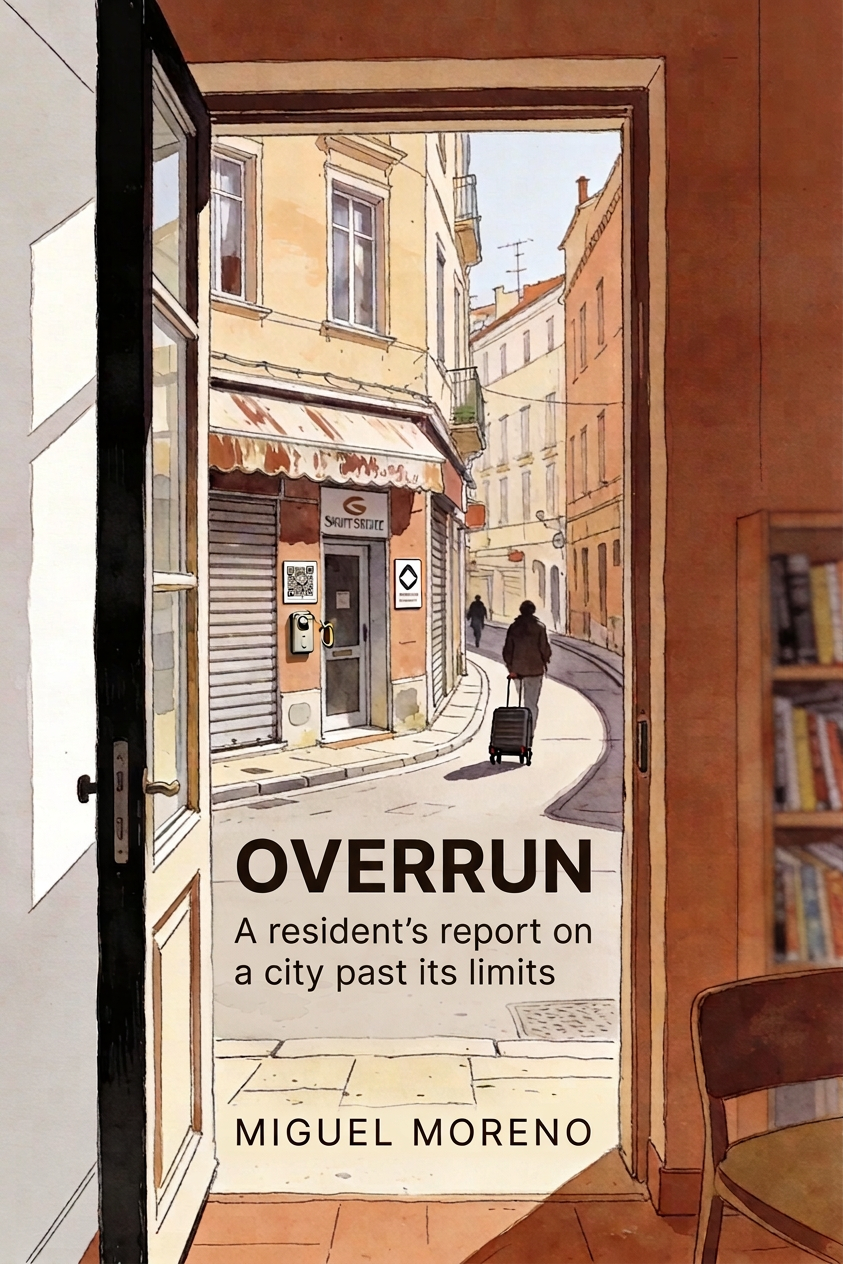
This volume was not intended as a study of urban decline. It began as an attempt to live, quietly, in a city one had previously managed to love at a manageable distance.
Civic Darwinism could well be a series of essays on the transformation of urban space — its habitability, its civic fabric, and the mechanisms by which it ceases, gradually and without announcement, to function for the people who live in it. The experiences that prompted this volume took place, for the most part, in a medium-sized Andalusian city of considerable architectural distinction — the kind of place that rewards prolonged attention and that has, in recent years, been rewarding a rather different kind of attention altogether. The narrator has lived, at various points, in other cities along the Mediterranean coast, and has found the essential pattern sufficiently consistent to suggest that the argument is not, in the end, parochial. It is, however, personal. The decision to write about urban degradation as a resident rather than as an analyst was taken at the precise moment I realised that what had seemed a local inconvenience was, in fact, a structural condition — and that its costs were being borne, in ways that did not invite easy equanimity, by people considerably less well-placed than I was to absorb them.
The five central chapters examine the city through five perspectives: the returning long-term resident, the daily commuter, the citizen without leisure, the flâneur in public space, and the modestly-paid professional who finds himself guiding a young Erasmus student through a rental market he has long since stopped questioning. That last task, I should add, feels less like assistance than like an unwilling audit of his own accommodation. These five are not exhaustive; they cover, between them, the ordinary range of urban experience — memory, mobility, the body, public space, and the condition of being a reliable guide to a place that has stopped being navigable.
The argument that follows is informed, in places it will signal rather than advertise, by Lefebvre’s insistence that urban space is a social product and that the right to inhabit it is a political claim rather than a consumer preference (1968). It is informed, in other places, by Cócola-Gant’s documentation of how tourism markets convert housing stock into a different kind of asset, and residents into a different kind of variable (2018). The remaining references — Zukin on the commoditisation of authenticity, Sennett on the erosion of public codes, Augé and Koolhaas on what is left when specificity has been engineered out — surface in the chapters where they become necessary, which is more often than I would have preferred.
A recent essay has proposed that what residents of transformed cities experience is best understood as a form of urban disaffection — a falling-out-of-love whose structure resembles the end of a personal relationship (Casado, 2026). The metaphor is apt in one respect: the estrangement is real, and the person experiencing it did not choose it. It is misleading in another: the causes are not emotional but institutional, and treating the condition as heartbreak risks exempting the responsible parties from the analysis.
A note on the narrator, in the third person, because some things are easier to say about oneself when one has briefly agreed to be someone else. He is a moderately qualified professional — qualified enough to know what the qualification cost, and experienced enough to have quietly accepted that the labour market has its own views on what that cost was worth. The postcode he inhabits is not the one he would have chosen; this has become, over time, less a source of grievance than a recurring confirmation of a suspicion he would prefer not to hold. What it has given him, as compensation of a sort, is an unusually attentive relationship with the indicators of urban habitability in the areas he knows well. He notes, with some discomfort, that when he was a student he had access, as a matter of course, to conditions adequate to the demands of a serious discipline: affordable, reasonably quiet, and not subject to the continuous small emergencies that the current housing market reserves for those who arrive in a city without a prior claim on it. He does not regard this as nostalgia. He regards it as a baseline — and its disappearance as a fact requiring explanation rather than acceptance.
A note on how this volume was composed is set out in the Note on Authorship and Method.
Granada, 2026
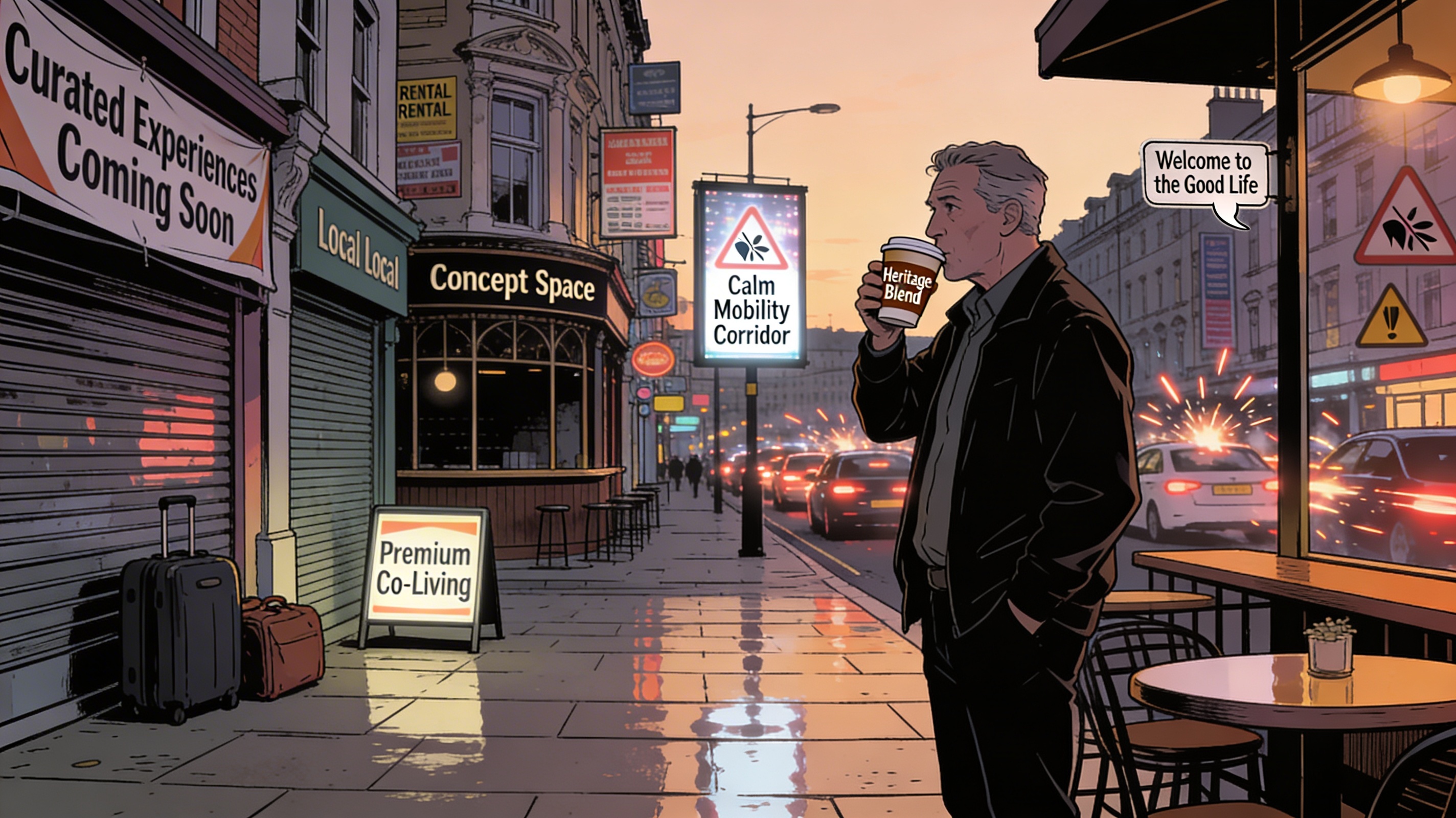
Plate I. Urban streetscape, city centre, western Europe, present day. A mature resident consumes a ‘Heritage Blend’ hot beverage whilst appraising signage that promises, in aggregate: curated experiences, a concept space, premium co-living, a calm mobility corridor, and the good life. A wheeled suitcase, unattended, occupies the pavement. The proprietor of the nearest establishment has chosen to describe his premises as ‘Local Local’, a formulation whose redundancy may be deliberate. Traffic conditions visible to the right have not been classified. The resident’s expression suggests familiarity. Provenance unknown; the scene has been documented in forty-seven cities without material variation.